On February 10, 2026, four top short-drama stars—Ke Chun, Chen Tianxiang, Yao Guanyu, and Zhang Chi—took the stage at the CCTV Online Spring Festival Gala, performing the song-and-dance show "The Episode We Love Most". On Lunar New Year's Day (February 17), Wang Xiaoyi, Wang Gege, Liu Nian, Lan Lan, Jin Zi, Yao Guanyu, Zhang Chi, Wu Tianhao, Wang Peiyan, and Yang Pengcheng will also appear at the Zhejiang TV Spring Festival Gala. Over the course of 2025, short-drama actors moved from being mocked as performers for audiences with "low taste" to walking the DIOR runway, stepping onto the Golden Rooster red carpet, and standing center stage at the CCTV Online Spring Festival Gala.
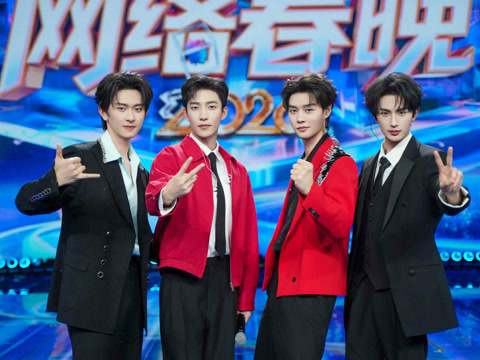
Top short-drama stars appear on the CCTV Online Spring Festival Gala (from left to right: Chen Tianxiang, Yao Guanyu, Ke Chun, Zhang Chi)
When short-drama actors stand in the most-watched studio in China, what they bring is the ultimate showcase of an industry's star-making system forged over the past two years. By January-February 2026, this mechanism—driven by platform revenue-sharing models, corporate-style talent management, CP economics, celebrity-look replication, and fan-circle voting culture—has already been tested repeatedly on national stages. Yet once the spotlights dim, a deeper question remains: Is their single night at the Gala a milestone marking their breakthrough into the mainstream—or the beginning of another cycle of rapid rise and rapid decline?
Industrial Foundations: From the Margins to Mainstream Scale
Appearing at the Spring Festival Gala has never been a matter of luck. It is the inevitable result of market size, user base, and commercial logic converging.
From 2025 to 2026, China's micro short-drama industry completed a qualitative leap—from a fringe entertainment format to a mainstream cultural phenomenon. In 2025, the market reached RMB 67.79 billion, up 34.4% year-on-year. It is projected to surpass RMB 90 billion in 2026, with some institutions predicting it could even reach RMB 120 billion—already exceeding traditional box-office revenue and becoming a key pillar of the digital content sector. User scale has grown accordingly. By 2025, micro short-drama users in China had reached 696 million, accounting for over 55% of internet users—meaning one in every two netizens has watched short dramas.
This expansion has not occurred in a vacuum. AI video tools have shortened production cycles to as little as one day per project and reduced costs by roughly 40%. The IAAP (In-App Advertising + Paid) hybrid monetization model has become widespread, with top platforms seeing single-series recharge revenue reach RMB 300 million. Short dramas, characterized by brevity, immediacy, and emotional payoff, fit perfectly into fragmented viewing habits. Users aged 18-30 account for 42.5%, those 40-59 for 36.7%, and viewers over 60 for 15.8%—a steadily growing segment. Short dramas are no longer the domain of "small-town youth", but a cross-generational national entertainment form.
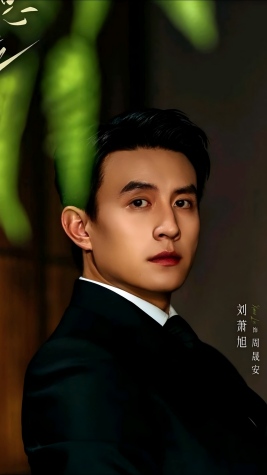
Short-drama actor Liu Xiaoxu
Within this ecosystem, actors completed their transformation from marginal figures to traffic centers. Ke Chun gained 1.5 million followers in a week after Save Myself, with his daily fee jumping from a few thousand yuan to RMB 80,000. Liu Xiaoxu ascended to the top in the assembly-line idol-making in 35 days; Summer Rose amassed 4.4 billion views. Guo Yuxin secured cooperation with Dior. The CP pairing of Han Yutong and Zeng Hui accumulated tens of billions of views across 13 collaborations.
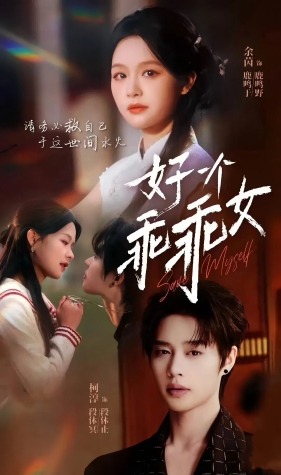
Poster for Save Myself
Yet beneath the expansion lies a stark divide. While top actors command RMB 80,000 per day, many mid- and lower-tier performers struggle to collect fees of just RMB 10,000, often working 18-hour days. The same system that creates rare upward mobility also places actors in a highly instrumentalized position—controlled by algorithms, traffic metrics, and capital.
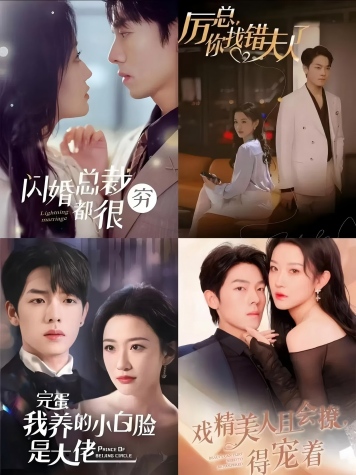
Short-drama CP actors Han Yutong and Zeng Hui (Source: Douyin account "laowu")
Platform Revenue Sharing: From Hourly Laborers to Partners
A landmark moment came in September 2025, when the platform Hongguo launched its Actor Partnership Program. Under the new model, income is split into "base pay + revenue share", directly linked to metrics such as views, completion rates, and user acquisition.

Hongguo's Actor Partnership Program launched in September 2025
Previously, short-drama actors were paid purely by daily rates, with no share in post-release performance. Actors must sign with the platform to participate, and the revenue share covers the entire lifecycle of the series. However, only about 5% of productions surpass the 1-million-view threshold required to qualify. For top actors, this can mean millions in additional income. For newcomers, survival still depends largely on guaranteed base pay.

The 2025 Hongguo Short Drama Annual Awards Announced the "Audience's Favorite Actress" and "Audience's Favorite Actor"
The specific rules of the Hongguo revenue-sharing mechanism include: actors must sign contracts to join the platform in order to participate in revenue sharing; the sharing ratio is no less than 10% and covers the entire lifecycle earnings of the drama; the revenue-sharing threshold is a single-drama viewership exceeding 1 million—though only 5% of short dramas in the industry reach this standard. This mechanism allows top-tier actors like Wang Kaimu and Xu Zhenzhen to earn 1.5 million and 1 million yuan respectively from revenue sharing for Half-Mature Husband, while newcomers or mid-tier actors primarily rely on guaranteed income, with daily salaries generally ranging from 15,000 to 30,000 yuan.

Poster for Half-Mature Husband (Source: Hongguo Short Drama weibo account)
A deeper transformation lies in the logic of resource allocation. Hongguo has tightly bound actor exposure to user acquisition: during its annual awards, fan activities such as inviting new users, daily check-ins, and commenting are directly converted into votes for actors. Each newly invited user earns 50 votes. During the 2026 Hongguo Awards, the platform intercepted 7.22 million fraudulent likes and 4.18 million fake reservations—figures that, in reverse, demonstrate how fan-organized ranking campaigns, account-switching to inflate data, and mobilizing friends and family for user growth have been systematically embedded into the platform's traffic operations. To secure exposure resources, actors must mobilize their fans to complete platform tasks; the platform, in turn, allocates traffic based on "voting rankings," forming a closed loop of "actors courting fans—fans voting and generating data—the platform harvesting growth."
The harshness of this mechanism lies in its asymmetry: while revenue-sharing income has no upper ceiling, guaranteed daily pay faces downward pressure. The platform's control over pricing power means that top actors' market rates of RMB 80,000 per day may be institutionally compressed, while mid-tier actors fall into survival anxiety—"no projects without signing; unstable income after signing." When Hongguo reconstructs actor valuation through an "account logic"—where 100,000 followers correspond to a RMB 10,000 daily rate, and Hongguo follower counts are directly converted into pay—short-drama actors are fully encapsulated as quantifiable data nodes.
Corporate Talent Management: From "Stars" to "Employees"
If platform revenue-sharing mechanisms have restructured the income rules for short-drama actors, then the corporate-style management of talent agencies has reshaped their sense of identity. Signing a contract becomes equivalent to onboarding; scheduling becomes a workstation assignment. Actors are no longer "objects to be made famous," but "allocated human resources." This new industry norm is rewriting the very definition of the word "actor."
First, project-based operations have replaced individual talent management. Traditional agencies center their mission on "making stars." Short-drama agencies, by contrast, center on deployment. After Wang Daotie, signed under Heard Island, went viral for his "uncle-circle domineering CEO" persona, he was repeatedly cast in similar projects such as "CEO revenge," "fake marriage, true love," and "flash marriage rebirth." At Xinglian Infinite Media, actors like Wang Gege and Liu Xiaoxu have their schedules, KPI targets, and genre positioning centrally managed by the company; agents function essentially as HR managers. As one industry insider joked, "Agents at short-drama companies are basically Foxconn line supervisors."
Second, data-driven KPI assessments have replaced artistic evaluation. Short-drama agencies have built actor rating systems comparable to those of major internet firms. If an actor's average completion rate across three projects exceeds 70%, the system automatically tags them as "Top A," granting priority scheduling. If three consecutive projects underperform, the actor is placed under "observation," or even assigned to low-budget trial productions. Data equals market value; rating equals resources. An actor's career trajectory becomes fully quantified. Meanwhile, training has shifted from refining acting craft to rapid skill acquisition—camera presence, emotional regulation, on-set adaptability—essentially standardized pre-job skills training.
Third, the "de-top-tier strategy" and risk diversification. Unlike traditional agencies that bet heavily on a single superstar, short-drama agencies widely adopt a "de-top-tier strategy." Even when an actor becomes a breakout hit, companies quickly disperse risk through strategies such as "veteran mentoring newcomer" binding CP pairings, or casting in in-house productions. While Liu Xiaoxu rose to the top in 35 days, Xinglian Infinite simultaneously launched new in-house talents alongside him. Han Yutong and Zeng Hui, as a real-life couple CP, collaborated on 13 projects—consolidating a traffic pool while reducing the risk of either party leaving. The company's core competitiveness shifts from "packaging ability" to "system capability," significantly weakening the threat of artist departures.
However, this corporate-style management model has also generated new tensions. Actors are downgraded from "stars" to "employees," challenging their professional identity. Companies' pursuit of maximum output has led to intensified workloads, with daily filming often lasting 16–18 hours. Data-driven assessments trap actors in anxiety over "views above all else," compressing space for artistic exploration. As one short-drama actor candidly admitted: "We're not filming—we're completing KPIs. If today's numbers aren't good, there may be no project for us tomorrow."
The CP Economy and Celebrity Lookalike Replication: The Double-Edged Sword of Traffic Operations
Within the short-drama star-making system, the CP economy and celebrity lookalike replication are two of the most recognizable mechanisms. Together, they form a "double-edged sword" in the traffic (audience) operations of short-drama actors—capable of rapidly producing top-tier stars, yet potentially constraining actors' long-term development. At their core, both mechanisms arbitrage existing market cognition: the former leverages audiences' emotional needs, while the latter capitalizes on established aesthetic preferences.
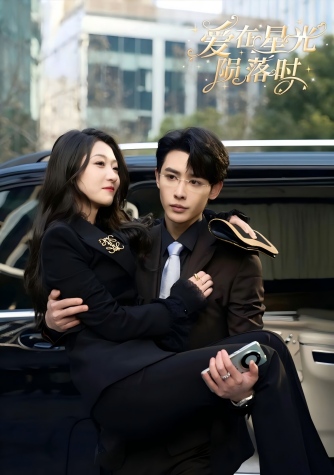
Short-drama CP actors Shen Haonan & Wang Gege
The core of the CP economy lies in transforming viewers' affection for a single production into long-term emotional investment in an actor pairing. Han Yutong and Zenghui collaborated 13 times as the "Tong & Hui" CP and are also a real-life couple, accumulating over 10 billion total views. Shen Haonan and Wang Gege have paired up 13 times across genres ranging from tragic romance to sweet love stories. Zhu Yiwei and Bai Xinyi, after 36 collaborations, are known as a "short-drama married couple." Sun Yue and Xu Yizhen, with 22 collaborations, remain the "white moonlight" couple of the short-drama sphere. High-frequency and high-density partnerships turn CPs into independent IPs that transcend individual productions—audiences are no longer chasing a show, but "this pair of couple."
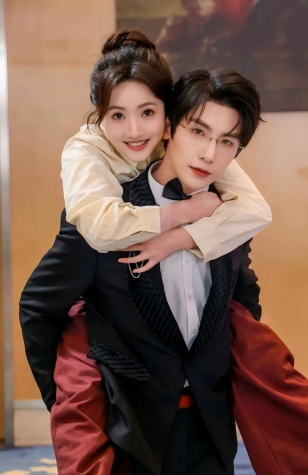
Short-drama CP Zhu Yiwei and Bai Xinyi in Mr He Snatched Me Away
Platforms have quickly recognized this trend and institutionalized CP operations. After Summer Rose became a hit, the platform promptly arranged interactive livestreams featuring Liu Xiaoxu and Guo Yuxin, upgrading fans from "spontaneously shipping" to being "systematically fed content." Platforms such as Hongguo Short Drama and iQIYI now explicitly schedule "CP promotion slots" in their publicity calendars, with joint livestreams, Chinese Valentine-themed photo spreads, and dual-cover magazine shoots as standard configurations. Shipping CPs has thus evolved from a fan-driven cultural practice into a platform-controlled traffic operation tool.
The commercial value of CPs has also achieved direct monetization. After Wang Tianchen and Gu Zicheng gained popularity through the "Ke Gu Ming Xin" CP in The White Olive Tree, they quickly received joint cover invitations from magazines such as CHIC and GLASS VISION, with single-issue sales exceeding 6,000 copies. CPs are no longer by-products of a drama's success; they are pre-designed production elements. Casting decisions consider "on-screen chemistry," scripts reserve "CP highlight moments," and dual commercial deals are launched immediately after broadcast.
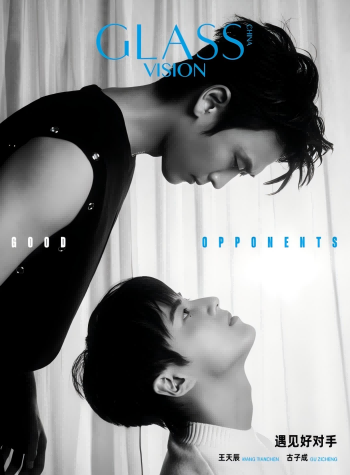
Wang Tianchen and Gu Zicheng on GLASS VISION magazine cover page
Celebrity lookalike replication is another shortcut in short-drama star-making. Its core logic is to arbitrage traffic by providing visually similar substitutes for top stars in long-form dramas. Yao Guanyu, whose appearance closely resembles Xiao Zhan and Yang Yang, was signed by Tangren Film & Television and quickly rose to top-tier status in short dramas. Li Youlin, branded as a "Jin Dong substitute" due to his resemblance to Jin Dong, captured middle-aged and elderly female audiences in the "silver-haired" market segment, with his daily pay jumping from thousands to tens of thousands of yuan. Casting directors operate on a clear logic: if viewers cannot distinguish the difference at first glance, the crucial first three seconds—"who does he look like?"—directly determine retention rates.
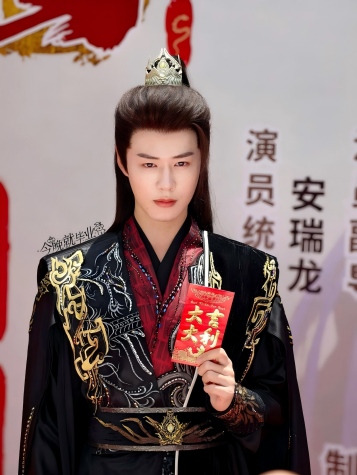
Li Youlin in The Cold Prince's Love Pursuit (source: Douyin account "jinwanjiubiye")
This "celebrity lookalike replication" mechanism rests on precise data logic: the visual anchoring effect—audiences' aesthetic preferences for long-drama idols have already been market-validated, and replicating facial structure, eyes, and overall aura significantly lowers cognitive costs; cost-performance arbitrage—long-drama idols command salaries in the tens of millions and have schedules booked years in advance, while short-drama "lookalikes" earn around ten thousand yuan per day and are readily available, allowing brands and producers to obtain 70% visual similarity at 1% of the cost; risk hedging—top long-drama idols carry reputational risks, whereas lesser-known substitutes can be swiftly replaced if controversy arises, with minimal switching costs.
Yet both mechanisms contain inherent paradoxes. The CP economy turns actor relationships into reproducible production formulas; overreliance on CP bundling may limit individual career development, and once a CP dissolves, both parties' traffic can shrink dramatically. As several producers admit, "What audiences remember is 'the pair,' not the actors themselves." Celebrity lookalike replication, meanwhile, makes it difficult for actors to establish distinct personal identities. When resemblance becomes a casting "matching game," the path for an actor to evolve from a "shadow" into a "light source" is increasingly narrowed by homogenized roles and rapid production cycles. As one short-drama director put it: "What audiences remember is 'the one who looks like Xiao Zhan,' not 'the actor Yao Guanyu.'"
Fan-Circle Voting Culture: Mobilizing Fans from "Audience" to "Voluntary Labor"
Another key force propelling short-drama actors onto the Spring Festival Gala stage is the organizational structuring of fan communities and the deep internalization of voting-and-ranking ("da tou") culture. At its core, the short-drama fan effect represents a low-cost replication and high-density transplantation of the idol-industry voting logic from China's mainstream entertainment sector into the vertical-screen era.
First, the institutionalization of fan organizations. Ke Chun has over 100,000 followers on his Weibo Super Topic, with a daily check-in rate as high as 18%. Data teams, image-and-video accounts, content creators, and influential "big fans" (verified accounts) are all in place. There are as many as 50 fan groups of 500 members each, with more than 20,000 core fans. These fans are not passive content consumers but active "drama-promotion laborers." For example, a fan of Shen Haonan known as Yaluo learned video editing from scratch and launched a Douyin account dedicated to creating derivative promotional content. A fan representative of Wang Yuwei revealed that the support club independently fundraises for birthday campaigns, coordinates with studios, and arranges offline billboard placements as part of a standardized workflow.
Second, the deep internalization of the voting mechanism. During the annual awards event hosted by Hongguo Short Drama, fans "complete daily tasks, check in, watch dramas, and post comments" to boost their idol's metrics—functioning much like digital laborers. The fan economy is no longer simply spontaneous emotional consumption; it has become labor input systematically mobilized by platform rules.
Third, the differentiated advantage of "rookie charm" and "authentic presence." Short-drama fans commonly note: they are drawn in by the drama but stay because of livestreams. Unlike the distant aura of long-form drama celebrities, short-drama actors spend substantial time interacting playfully with fans in livestream rooms—joking that "the moment I open my eyes, I have to lock someone's throat," standing on tables to sing, or chatting seamlessly with scrolling comments. Ma Xiaoyu reportedly counts fans reflexively upon meeting them and then takes them to buy drinks; Liu Xiaoxu is frequently seen giving back to fans through "reverse support." This grassroots narrative of "walking the journey together" dissolves the class distance embedded in traditional celebrity worship, offering fans an emotionally rewarding and highly cost-effective experience.
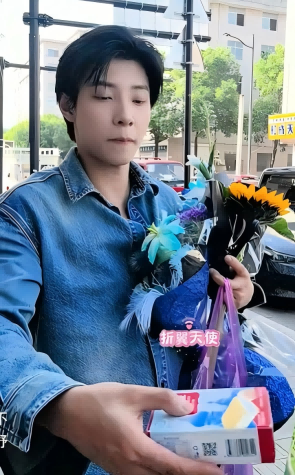
Short-drama actor Ma Xiaoyu is giving fans snacks (Source: Douyin account "zheyi & tianshi")
Fourth, the reverse intervention of fan power. The success rate of fan "wishes" in short dramas far exceeds that of mainstream entertainment. Requests such as "lock XXX into the XX genre" or "pair XX and XX again" are seriously considered by production teams and actors. Such deep fan involvement in career planning would be almost unimaginable in traditional film and television industries. The underlying logic is clear: short dramas have low trial-and-error costs and short production cycles, allowing fan feedback to be rapidly translated into casting adjustments in the next project. Fans are no longer passive recipients of content but invisible decision-makers within the production chain.
However, the full-scale infiltration of fan-circle culture has also introduced new concerns. Ranking disputes, demands for script changes, coordinated comment control, and aggressive voting campaigns—long-standing issues in China's idol fandom—have reemerged in the short-drama sector. He Jianqi reportedly fell into overnight silence after revelations from a top-spending fan, with his commercial value dropping by 60%. The alienation of fan culture not only increases industry operating costs but also distorts creative direction, weakening the core "decentralized" advantage that once defined short dramas.
Capital Operations and Technological Empowerment: The Reconstruction of Commercial Value and the Impact of AIGC
In the mainstreaming of short-drama actors, capital and technology have played dual driving roles. On the one hand, capital has helped liberate actors from the highly exploitative, non-negotiable position of "data sharecroppers"; on the other hand, through more advanced forms of interest binding, it has absorbed them into capital alliances, thereby achieving deeper structural control. Meanwhile, technology—particularly AIGC—has reduced costs and increased efficiency, installing an acceleration engine onto the star-making assembly line.
In terms of investment flows, capital has constructed a systematic star-production ecosystem through the interweaving of five driving forces: platform revenue-sharing mechanisms, corporate-style management by agencies, CP economy operations, celebrity lookalike replication strategies, and fan voting culture. From 2024 to 2025, leading short-drama production companies completed multiple rounds of financing. Zhong Xing Film built a thousand-mu short-drama ecological industry base in Nanjing, with total investment exceeding 600 million RMB. Capital is no longer satisfied with "betting on breakout hits"; instead, by signing actors, locking in IP, and controlling distribution channels, it has upgraded short dramas from a "product" to an "industry."
In terms of commercial value reconstruction, capital has pushed short-drama actors to transition from single-income models to diversified monetization. Under revenue-sharing schemes, top actors can earn over 1.5 million RMB per series. In brand endorsements, Ke Chun, as brand ambassador for MAN WEIMING, generated over 220 million impressions for the brand. In livestream e-commerce, He Jianqi achieved a single-session Gross Merchandise Volume (GMV) exceeding one million RMB. In commercial integrations, Li Keyi and Wang Peiyan incorporated the WINONA livestream studio into the narrative of The 18-Year-Old Great-Grandma Has Arrived, pioneering a model in which "the character is the scenario, and the plot is the selling point."
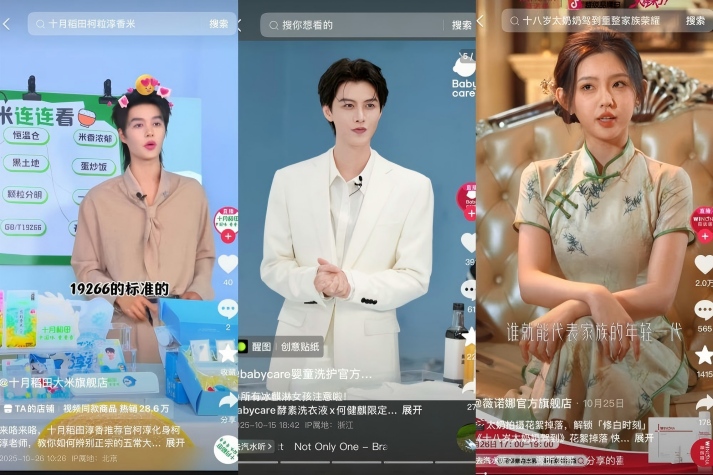
On the day The 18-Year-Old Great-Grandma Has Arrived: Restoring the Family Glory 3 premiered, the drama's leads Li Keyi and Wang Peiyan directly integrated WINONA's live streaming room into the storyline. (source: DoNews)
Capital has also given rise to a trend of "actor capitalization." Xu Yizhen acquired a 30% stake in Longyi Film, participating deeply in script approval and budget review, forming a commercial closed loop of "content + e-commerce + artist management," with monthly GMV surpassing 8 million RMB. This capitalization upgrade transforms actors from "employees" into "partners," yet introduces new risks: commercial value becomes deeply bound to personal image, and any controversy can rapidly evaporate that value.
At the same time, AIGC technology is profoundly reshaping both production workflows and actors' career trajectories. On the production side, AIGC tools—such as text-to-video generation, intelligent storyboarding, and virtual scene creation—have compressed traditional short-drama production cycles from weeks to days, reducing costs to less than one-tenth of on-location shooting. Shanghai Film Group's production of Soul Detective adopted full-process AIGC assistance, shortening production time by 50% and lowering costs by 70%.
In terms of actor development, AIGC has also given rise to the emerging category of the "AI actor." BONA Film Group launched the AI actor "Wu Xingyan," who accumulated millions of followers through social media operations and secured multiple brand endorsements, demonstrating commercial advantages such as stable persona design, high customizability, and efficient output. However, technology has not fully replaced human performers. The president of Beijing Film Academy, Hu Qiang, has pointed out that digital characters supplement rather than replace traditional performance, with their core limitation being the inability to fully embody "the essence of humanity." Human actors remain irreplaceable in emotional expression and in shaping the soul of a character.
Challenges and Sustainable Pathways: Hidden Concerns After the Move into The Mainstream
Short-drama actors appearing on the Spring Festival Gala stage marks a highlight moment in the industry's mainstreaming process. Yet it is precisely after "getting a seat at the table" that deeper structural problems demand attention.
Income polarization is the most prominent pain point. The daily pay gap between top-tier and entry-level actors can reach as high as 300 times. Producers face a dilemma: for female-oriented dramas, not casting top-tier actors may result in heavy losses, yet hiring them severely compresses profit margins, with actor fees sometimes accounting for over 60% of the total budget. More critically, short-drama actors generally have short career lifespans—"a monetization window of less than three months" has become industry norm. Ke Chun has been popular for barely a year, yet a new batch of "Short-Drama F4" is already waiting in the wings. Ma Qiuyuan, after unsuccessfully venturing into long-form dramas, returned with Unexpectedly, We Meet Again, which delivered mediocre performance data and drew online ridicule that "a faded top star is worth less than nothing."
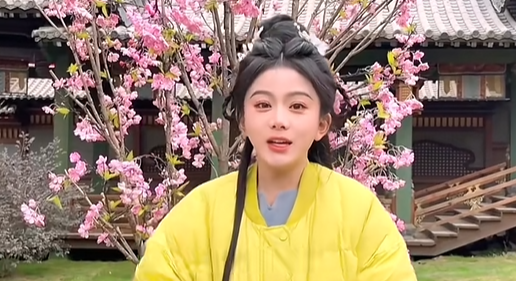
Short-drama actor Ma Qiuyuan
Data manipulation and the alienation of fan culture are further eroding industry health. During the annual awards event hosted by Hongguo Short Drama, practices such as artificial "likes" and inflated reservation numbers exposed the severity of data bubbles in the short-drama sector. When fan voting becomes hard currency for traffic allocation, actors' real influence is diluted by inflated metrics, trapping the industry in a cycle of "boost data—gain traffic—boost data again."
Health risks and labor protection issues are becoming increasingly visible. Short-drama actors often work 16-18 hours per day, and high-intensity shooting schedules frequently lead to health problems. Meanwhile, the industry lacks unified professional standards and protection mechanisms, leaving lower-tier actors vulnerable to wage arrears and difficult rights protection. In January 2026, actress Yang Meimei revealed that more than six months after wrapping a project, her payment had still not been settled—and she had never signed a written contract with the production team. This is not an isolated case, but a reflection of the industry's norm of "verbal agreements first, work first, settle later."
The advancement path for short-drama actors now faces multiple tests. How can this wave of "traffic dividends" be converted into "long-term career sustainability"? Several directions may offer guidance:
1. Break free from the "short-drama acting style" and establish professionalism. Ke Chun attempted more nuanced performances in the long-form drama Never-ending Summer, while Guo Yuxin leveraged her formal training to return to period dramas. Their efforts suggest that moving beyond "shouting-style acting" and "expressionless delivery" is essential for transitioning from "traffic-driven" to "performance-driven" careers.
2. Go beyond acting and become creators. Sun Yue has shifted toward screenwriting and directing; Wang Gege established her own studio; Xu Yizhen invested in a production company. Increasingly, short-drama actors are transitioning from "performers" to "creators." For them, short dramas need not be a mere stepping stone—they can also be a career destination.
3. Improve institutional frameworks and move from individuals to a professional community. Hongguo Short Drama has launched a qualification inquiry system for partner institutions, while the Tongzhou District People's Court in Beijing has issued judicial determinations on labor relations in short-drama employment. The industry is beginning to install its own "regulatory brakes." Actors transitioning from "going solo" to formal contracts represent not only platform consolidation, but also the rooting of contractual awareness.
4. Embrace technology without being controlled by it. AIGC can shorten production cycles and lower trial-and-error costs, but it cannot endow characters with a soul. The casting principle articulated by the chief producer of My Sweet Home is thought-provoking: "Those who want to be idol celebrities—we don't sign. Those who want to focus on fan operations—we don't sign. Those who treat short dramas as a stepping stone to long dramas—we don't sign. Short dramas are not a stepping stone; they can be the future and the destination."
Conclusion
This star-making system—driven by platform revenue-sharing mechanisms, corporate-style agency management, CP economics, celebrity lookalike replication, and fan voting culture—can propel an unknown actor to top-tier status in just 35 days, yet can also push them to the edge of a career cliff with a single negative trending topic. Are micro short dramas cultivating genuine actors, or mass-producing fast-consumed emotional commodities? When short-drama actors appear on the Spring Festival Gala stage, is it a fleeting flash or the final piece of mainstream integration? The answer may not depend on how long they can stand under the spotlight of national television, but on whether—after stepping away from the glare—they still retain a name remembered by audiences, roles recognized by the market, and professional dignity respected by the industry. (Author / Wen Yanqing, Editor / Cheng Yingzi)