
The millennia-old charm of salt quietly flows through the Zhuotongjing Site Park in Guanchang Village, Zhuotongjing Town, Daying County, Suining City. Strolling through the park, the weathered old well of Dashun Stove, aged bamboo water-lifting machines, and rustic salt cauldrons dot the landscape. Each of these timeworn objects—soaked in brine and etched with toil—silently tells the thousand-year saga of how the Chinese have, since the Northern Song Dynasty, unlocked the underground treasures and rewritten the history of world drilling.
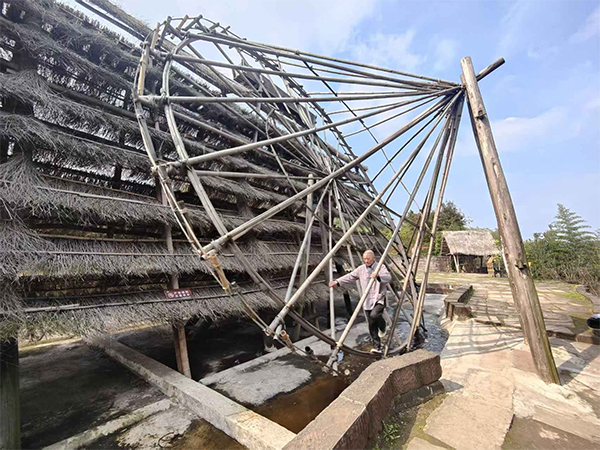
Ancient salt-making craft display
Covering an area of over 200 mu (approximately 33 acres), the Zhuotongjing Site Park preserves in their entirety 8 ancient salt wells, 1 former salt worker's residence, a salt-drying terrace, giant brine-drying racks, bamboo water-lifting machines, and 20 goat-horn windlasses, along with 141 pieces of traditional production implements—including measuring vats, old-style salt cauldrons, and wooden brine barrels. Together, they faithfully reproduce the entire technological process of well-sinking, brine-lifting, brine-drying, and salt-boiling as practiced in the Song Dynasty.
The Zhuotongjing (bamboo-tube well) was born during the Qingli reign of the Northern Song Dynasty. Our ancestors pioneered the impact-type percussive drilling method, using circular-edge drill bits to bore wells and moso bamboo as casing to seal off shallow freshwater layers. With only human-powered wooden rigs, they could drill wells up to a hundred meters deep. This technology predates comparable Western drilling techniques by over 700 years, earning it the titles "Father of the World's Oil Drilling" and "the Fifth Greatest Invention of Ancient China."
In the past, salt workers relied on reading geological veins to find brine, sinking tubes into the wells, lifting brine, drying it in the sun, and boiling it in iron cauldrons—day after day, drawing brine from deep underground and sustaining the thousand-year salt industry of northern Sichuan. Today, modern oil and gas drilling equipment can be found in oilfields across the globe, yet the original techniques remain remarkably preserved in the countryside of Daying. The old wells and ancient implements stand as vivid physical testimony to the history of human drilling and exploration.
1、“國際在線”由中國國際廣播電台主辦。經中國國際廣播電台授權,國廣國際在線網絡(北京)有限公司獨家負責“國際在線”網站的市場經營。
2、凡本網註明“來源:國際在線”的所有信息內容,未經書面授權,任何單位及個人不得轉載、摘編、複製或利用其他方式使用。
3、“國際在線”自有版權信息(包括但不限于“國際在線專稿”、“國際在線消息”、“國際在線XX消息”“國際在線報道”“國際在線XX報道”等信息內容,但明確標注為第三方版權的內容除外)均由國廣國際在線網絡(北京)有限公司統一管理和銷售。
已取得國廣國際在線網絡(北京)有限公司使用授權的被授權人,應嚴格在授權範圍內使用,不得超範圍使用,使用時應註明“來源:國際在線”。違反上述聲明者,本網將追究其相關法律責任。
任何未與國廣國際在線網絡(北京)有限公司簽訂相關協議或未取得授權書的公司、媒體、網站和個人均無權銷售、使用“國際在線”網站的自有版權信息産品。否則,國廣國際在線網絡(北京)有限公司將採取法律手段維護合法權益,因此産生的損失及為此所花費的全部費用(包括但不限于律師費、訴訟費、差旅費、公證費等)全部由侵權方承擔。
4、凡本網註明“來源:XXX(非國際在線)”的作品,均轉載自其它媒體,轉載目的在於傳遞更多信息,豐富網絡文化,此類稿件並不代表本網贊同其觀點和對其真實性負責。
5、如因作品內容、版權和其他問題需要與本網聯繫的,請在該事由發生之日起30日內進行。