As technology and culture become increasingly intertwined, new possibilities are emerging for how civilizations tell their stories. China's rich cultural heritage—shaped over thousands of years—now calls for forms of expression that are both contemporary and globally resonant.
How can stories rooted in millennia of Chinese civilization become understandable, relatable, and compelling in today's world? How can culture and technology move forward together in ways that truly connect with people and engage global audiences? These are not only defining questions of our time, but also essential challenges China must address in an increasingly interconnected world.
China's 15th Five-Year Plan explicitly calls for enhancing the international communication capacity and influence of Chinese civilization, while accelerating the development of a Chinese discourse and narrative system. Against the backdrop of deepening integration between culture and technology, capacity building serves as a critical foundation for combining cultural depth with technological innovation, offering a practical pathway toward a globally influential narrative system suited to the digital age.
I. Capacity Building: The Essential Foundation for Telling China's Story Through Cultural-Technology Integration
Strengthening capabilities across talent development, technology application, and international communication is essential for turning cultural-technology integration into meaningful practice. It is also the key to ensuring that China's stories possess both historical depth and contemporary relevance, enabling them to resonate with audiences around the world.
The most valuable resource in this field is interdisciplinary talent—individuals who understand culture, can apply technology, and are capable of communicating across cultures. Establishing training systems that bring together intangible cultural heritage inheritors, young creators, designers, and international communicators is therefore essential. Empowering more people with the ability to "tell cultural stories through technology" lays the groundwork for sustainable innovation in Chinese storytelling.
Digital capabilities are opening entirely new possibilities for presenting traditional culture in contemporary ways. Cultural heritage can now be digitally restored, intangible cultural heritage can be intelligently translated into new formats, historical scenes can be recreated immersively, and traditional IPs can be reimagined through cross-disciplinary innovation. Digital technology is no longer merely a tool for improving communication efficiency—it has become a core engine for reshaping cultural expression, expanding narrative boundaries, and enhancing emotional impact. Through these innovations, Chinese civilization can be experienced in ways that are more vivid, intuitive, and engaging for global audiences.

[Photo via VCG]
Ultimately, telling China's story effectively requires building cross-cultural understanding. This means communicators must understand both China and the wider world, both content and audiences. In this context, the value of capacity building lies in strengthening empathy, dialogue, and mutual learning—transforming communication from one-way transmission into two-way exchange, and from cultural display into value-based resonance.
II. From Concept to Practice: Real-World Pathways for Cultural-Technology Integration
Capacity building must go beyond abstract ideas. It should become a systematic effort embedded throughout the entire process of creation, transformation, communication, and collaboration. Today, a number of replicable and scalable practices are emerging in areas such as intangible cultural heritage revitalization, digital creativity, and international communication.
Revitalizing Intangible Cultural Heritage Through Digital Collaboration and Capacity Building
Intangible cultural heritage (ICH) is one of the most vibrant carriers of Chinese stories. Yet traditional inheritance models often face challenges such as limited communication channels, insufficient innovation, and weak industrial integration.
Against the backdrop of global digital governance and coordinated cultural heritage protection, stakeholders are actively exploring sustainable technology-driven approaches. The World Internet Conference has established a specialized committee on cultural heritage digitization, bringing together museums, universities, industry associations, international organizations, and leading technology companies to explore how digital technologies can help preserve shared human values and contribute to inclusive global digital governance.
In response to East Asia's needs for cultural innovation and sustainable ICH development, the UNESCO Regional Office for East Asia launched the two-year "ICH as Fashion" capacity-building initiative for 2025 to 2026. Recently, the Workshop 5 · ICH as Fashion Tech-Enabled Translation and Systems Innovation for ICH, co-organized by the International Centre for Creativity and Sustainable Development under the auspices of UNESCO (ICCSD) and Beijing Institute of Fashion Technology, concluded successfully in Beijing, attracting over 50 participants from around the world.
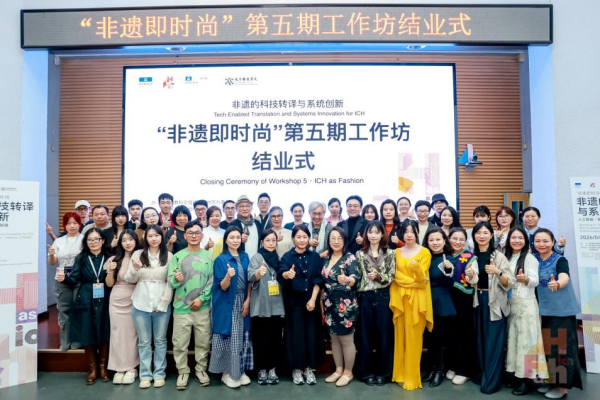
The guests and trainees took a group photo at the graduation ceremony
The workshop focused on the application of artificial intelligence, digital design, and cultural intelligence systems in transforming ICH into contemporary fashion innovation. Participants widely noted that the program helped address longstanding challenges in making heritage more youth-oriented and trend-conscious. They also emphasized that digital technologies are powerful tools for improving creative efficiency, expanding forms of expression, and lowering communication barriers—allowing ICH to evolve from static displays into virtual experiences, three-dimensional interactions, and immersive storytelling better aligned with contemporary audiences and market demands.
Digital Creation: Expanding the Boundaries of Chinese Storytelling Through New Technologies
Digital creation has become one of the most dynamic forms of cultural-technology integration, opening new storytelling pathways that are more innovative, diverse, and globally accessible.
Emerging technologies such as AIGC, virtual interaction, and digital imaging are dramatically lowering creative barriers while expanding imaginative possibilities. More creators are now able to participate in innovative interpretations of Chinese stories.
Professional competitions and cross-disciplinary collaborative programs are becoming important platforms for cultivating digital creative talent. Since 2024, the Beijing International Film Festival has officially introduced an AIGC film section—the world's first festival unit dedicated to AI-assisted filmmaking. This year's festival also launched a creation camp for AIGC science films where 19 interdisciplinary teams completed full-scale AI-assisted film productions within 48 hours. Outstanding works will later be screened through science museum cinema networks, bringing technological and artistic innovation to wider audiences.
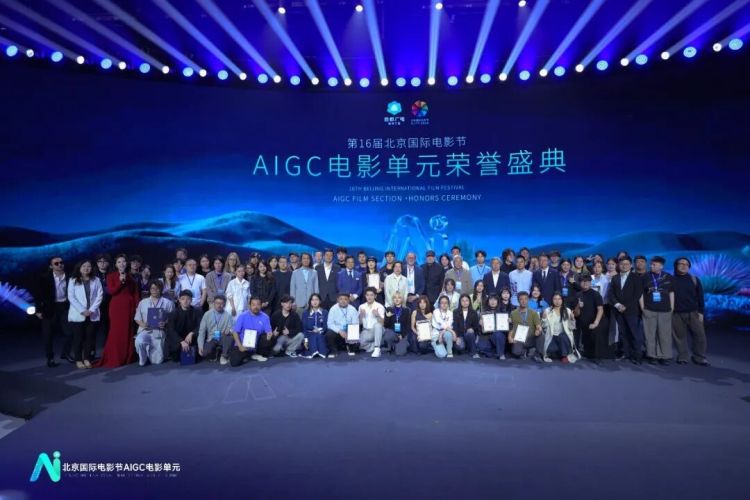
Group photo of the scene
[Photo via the Offcial WeChat account of the BJIFF]
Beyond professional filmmaking, international design initiatives are also nurturing digital creativity. The "Design Marathon", launched by Beijing Institute of Fashion Technology, has brought together hundreds of universities and thousands of young designers worldwide to collaborate on themes such as cultural innovation and sustainable lifestyles. In the 2022 "Elegant Living" program, one notable project combined the classic Chinese opera The Peony Pavilion (牡丹亭) with virtual wearable technologies, reinterpreting traditional cultural imagery through digital language.
International Communication: Building Global Resonance Through Mutual Learning
To tell China's story well, China must engage with the world through dialogue, cooperation, and mutual understanding. The essence of international communication lies in fostering understanding and shared values through exchange among civilizations.
Capacity-building and experience-sharing programs aimed at countries participating in the Belt and Road Initiative have become effective channels for enhancing international communication.
Since 2019, a series of programs focusing on creative design, technological innovation, and urban renewal have been conducted for participants from Belt and Road partner countries. These initiatives share China's experiences in creativity and sustainable development while promoting cultural exchange and collaborative innovation.
On April 15, 2026, the 2026 Belt and Road Creativity and Sustainable Development Seminar, jointly organized by ICCSD and the School of International and Public Affairs at Jilin University, was successfully held in Beijing. Participants from 13 countries, including Zimbabwe, Kenya, and Ghana, explored pathways for technological innovation, urban renewal, and sustainable development through lectures and field visits.
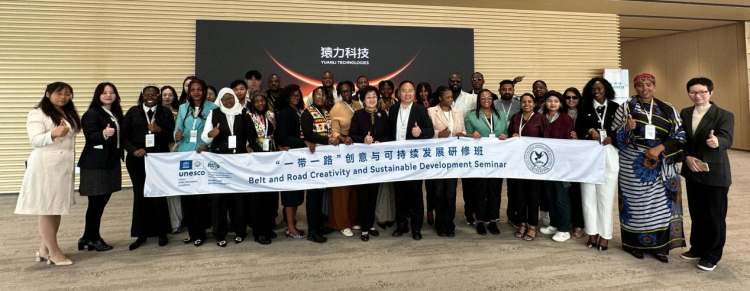
Group photo of seminar participants
[Photo by Zhang Lishuo]
Zimbabwean participant Kelvin Gwanzura noted that discussions on targeted poverty alleviation, grassroots governance, and policy implementation were particularly inspiring and highly relevant for developing countries. Sierra Leonean participant Jagitay Salamatu described her visit to China as "one of the best experiences" of her life, emphasizing that "creativity, innovation, and technology are the keys to solving future development challenges".
III. Deeper Value: Achieving Sustainable and High-Quality Global Communication
Continuous investment in capacity building and deeper integration of culture and technology can not only broaden the reach of Chinese stories, but also fundamentally enhance their narrative depth, communication forms, and international influence.
First, it promotes the creative transformation and innovative development of traditional Chinese culture. Cultural resources are no longer confined to archives and museums, but are transformed into experiential, communicable, and sustainable digital content and cultural IPs that allow ancient civilization to thrive in contemporary society.
Second, it enables a transition from "technology showcase" to "value communication." Cultural-technology integration should not become merely a display of technical sophistication. Instead, it should focus on conveying Chinese values, philosophies, and cultural spirit in ways that help global audiences understand the humanistic foundations behind China's stories.
Third, it promotes mutual learning among civilizations and contributes to global sustainable development. China shares its experiences while also learning from other cultures, fostering a more open and interactive model of communication that resonates more effectively with global audiences and supports the implementation of the United Nations 2030 Sustainable Development Goals.
From the digital revitalization of intangible cultural heritage to young creators using AI and visual storytelling to reinterpret Chinese culture; from cross-border capacity building to sustained civilizational dialogue—a new narrative ecosystem is quietly taking shape, with capacity building as the bridge and cultural-technology integration as its driving force.
In the digital era, ancient cultural traditions need not remain bound by convention, nor must cutting-edge technologies exist in isolation. As more people gain the confidence and capability to tell China's story well—and as tradition and innovation, China and the world, increasingly move toward one another—the wisdom, aesthetics, and spirit of Chinese civilization will naturally reach wider audiences in ways that are lighter, more compelling, and more sustainable.