
Academicians Discuss Future of AI at WAIC 2026 Sub-Forum
The "New Voices, Returning to the Tide: AI Shanghai" Innovation Resource Matchmaking Conference — also staged as the 2026 Young Overseas Chinese Tech Dialogue — was held in Shanghai on July 18, as part of the 2026 World Artificial Intelligence Conference (WAIC). The event brought together more than 170 overseas Chinese professionals from 14 countries and regions, including the United States, the United Kingdom, and Australia.
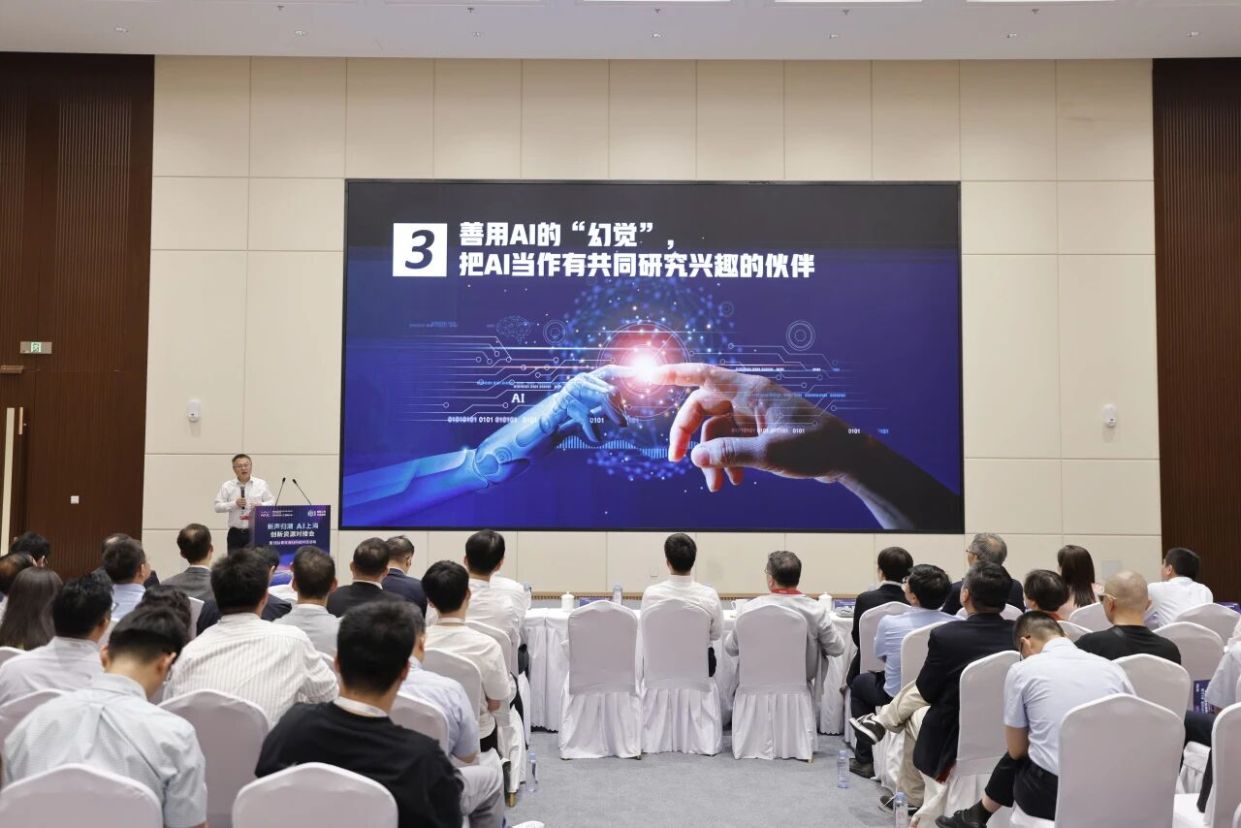
In a keynote speech, Shen Weixiao, academician of the Chinese Academy of Sciences, dean of the School of Mathematical Sciences at Fudan University, and president of the Shanghai Association of Overseas Chinese Professionals, delivered a clear message: "At this point in time, no one can use a lack of understanding of AI as an excuse to reject it."
Shen acknowledged that mathematicians tend to be cautious about "black box" models. However, he emphasized that AI's ability to lower barriers between disciplines and free researchers from routine derivations is already indispensable. He even remarked, half-jokingly, that AI "hallucinations" can serve as a kind of companion for theoretical researchers.
Citing the International Mathematical Union's Leiden Manifesto, Shen noted that while AI "never forgets and never tires", it "cannot solve all problems". Ultimately, true innovation still depends on human creativity. Drawing on his own experience having returned to China years ago, he encouraged overseas talent to seize the current window of opportunity — an era where uncertainty and possibility coexist.
Echoing this call for a shift in thinking, Guo Yike, foreign member of the Chinese Academy of Engineering and provost of Hong Kong University of Science and Technology, offered a more radical prediction: traditional, static academic papers could disappear within five years.
He proposed replacing conventional papers with "living subject" that integrate narrative, evidence, executable code, and validation processes, creating a dynamic research format for human–AI collaboration. This concept is already being advanced under his editorial leadership at the international journal AI for Engineering. "We hope to see this model take root in China first", he said, "and become a milestone in the global transformation of scientific research."


- Tel:+86-010-68891122
Copyright ©1997- by CRI Online All rights reserved
