
beijing
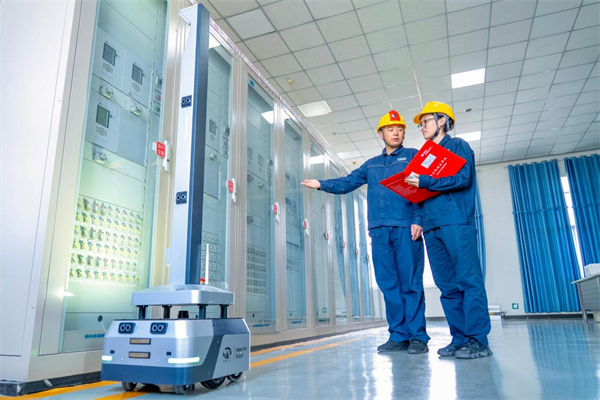
A compact inspection robot performing its duties
Photo by Nie Fandi
During the critical summer peak demand season, ensuring reliable power supply is a priority. At the Qiaoying Substation of State Grid Xiangyang Power Supply Company, the dense arrangement of protection panels, switching links, and instruments in the secondary system—combined with narrow aisles and uneven lighting in the main control room—has long posed significant challenges for routine manual inspections. As one of the 67 intelligent inspection devices recently deployed by Xiangyang Power Supply, this nearly 1.7-meter-tall compact inspection robot, operating in coordination with drones and HD surveillance cameras, forms an integrated air-and-ground inspection system. This deployment fills a gap in unmanned indoor inspection of substation panels and cabinets.
Equipped with a sensor fusion system combining a 360-degree LiDAR and ultrasonic sensors, the robot navigates narrow aisles flexibly. Its mobile chassis, capable of overcoming 15 mm obstacles, travels smoothly over cable trench covers and autonomously plans detour routes when encountering obstacles; the onboard 8K high-definition camera, paired with continuously adjustable fill lights, captures clear details of instruments and switches even in low-light conditions. Upon completing an inspection, the robot automatically stitches the panel images and transmits them in real time to the central inspection management platform via an encrypted wireless network.
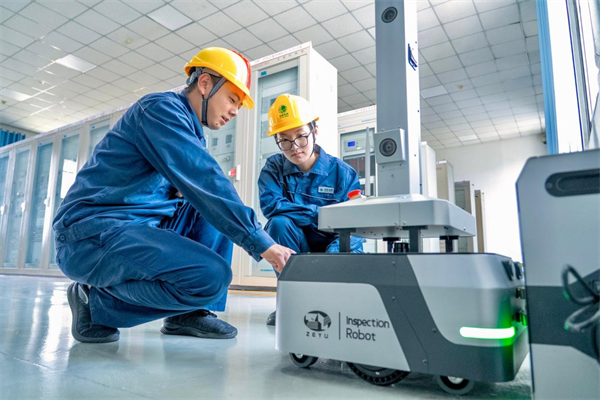
Power maintenance personnel checking the operating status of the compact inspection robot
Photo by Nie Fandi
The robot utilizes a modular, lightweight design featuring a powerful central platform and lightweight terminals, resulting in low maintenance costs. Supported by a smart base station, it boasts a 10-hour battery life, automatically returns to charge when battery levels drop, and can independently complete inspections offline even if the network is disconnected.
According to the company, these intelligent devices are reshaping the maintenance paradigm. Maintenance teams no longer need to travel to substations for routine inspections; instead, they can remotely verify robot-generated inspection reports, freeing up personnel to focus on core tasks such as defect analysis and fault handling. The company will conduct a three-month trial period, during which it will continuously gather feedback from frontline operators to optimize identification algorithms and human-machine interaction functions, aiming to gradually achieve full replacement of routine manual inspections. (By Du Yuan, Nie Fandi, Song Pin)


Copyright ©1997- by CRI Online All rights reserved
