
beijing
Recently, the closing ceremony for the "Bayu Culinary Culture Tour" program for Swiss students was held at Chongqing Business Vocational College. Twenty-five Swiss students received the Belt and Road International Skills Certificate and their training completion certificates. Centered on Bayu cuisine as a cultural bridge, the program pioneered innovations in vocational education cooperation models, skills certification systems, and cultural communication pathways, becoming a new practice in Sino-Swiss cultural exchange and skills integration.
It is understood that the 18-day "Bayu Culinary Culture Tour" program featured a meticulously designed and systematic curriculum totaling 110 academic hours. Leveraging the professional faculty of the school of Culinary and Food Science at Chongqing Business Vocational College and platform resources such as the World Skills Competition training base, the program adopted a tripartite teaching model integrating theory, hands-on practice, and culture learning.
Unlike conventional short-term training programs, this initiative combined professional expertise with cultural immersion. On the technical level, participants gained hands-on experience in hotpot base preparation, ingredient handling and preservation, and specialty hotpot dish creation, progressively mastering core skills aligned with the Level 5 qualification standards for Chinese Cuisine Chef (Hotpot Chef). On the cultural level, the curriculum incorporated Mandarin, tea art, Chinese painting, and Tai Chi pertaining. Through visits to urban landmarks like Hongya Cave and Ciqikou Ancient Town, participants experienced the charm of the "8D magical city" and gained a deeper understanding of the cultural essence of hotpot as a symbol of inclusiveness and coexistence.
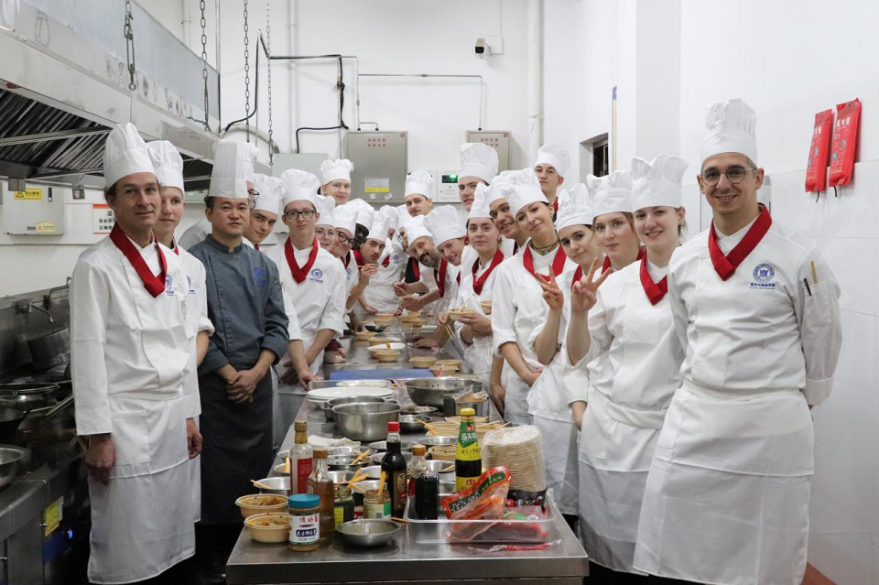
Photo from the project training site
Photo provided by Chongqing Business Vocational College
At the closing ceremony, Swiss lead instructor Alfred Erhard Gick remarked: "This culinary philosophy of transforming the ordinary into the extraordinary with every knife stroke, chopping board, pot and spoon inspires profound respect for Chinese culinary culture." The program also established a two-way exchange platform, where Swiss instructors showcased Western culinary techniques, bringing innovative international perspectives to Chinese culinary education.
As a core innovation of this program, Chongqing Occupational Skill Testing Authority (Belt and Road International Skills Certification Center) and Chongqing Business Vocational College jointly introduced a "one-assessment, dual-certificates" model. This approach integrates the elementary-level certification for Chinese Cuisine Chefs (Hotpot chefs) with the Belt and Road International Skills Certificate. At the closing ceremony, participants received both certificates, and they will subsequently be awarded the Level 5 Chinese Cuisine Chef (Hotpot Chef) certificates.
Jia Xiaobo, Vice President of Chongqing Business Vocational College, stated that as a Belt and Road International Skills Certification Service Station, the college has consistently upheld the philosophy of "cultivating talent through skills and enriching minds through culture." In this program, the meticulous professionalism displayed by the Swiss participants complemented the captivating Bayu culture shared by Chinese faculty and students, giving the "Study in Chongqing" initiative renewed warmth and appeal. Looking ahead, he expressed hope to organize reciprocal visits to Switzerland and deepen long-term Sino-Swiss cooperation in culinary innovation and vocational education resource sharing.




Copyright ©1997- by CRI Online All rights reserved
