
beijing
In the shimmering Shengsi waters of Zhoushan, the ebb and flow of the tides conceal the safety secrets of the undersea energy lifeline. Recently, State Grid Zhoushan Power Supply Company's "Guojiao No.1" (國蛟一號) unmanned system has been upgraded with a powerful new asset: a Nearshore Underwater Pipeline Survey Catamaran USV, operating in concert with an Aerial Magnetic Survey UAV and an Underwater Inspection ROV, the system conducted its first-ever integrated air-sea inspection of an intertidal submarine cable in the Gouqi waters of Shengsi, Zhejiang, China. This technological feat, integrating "Air-Sea-Undersea" coordination, marks a milestone in China's intertidal submarine cable O&M into a new era of all-scenario intelligent management.
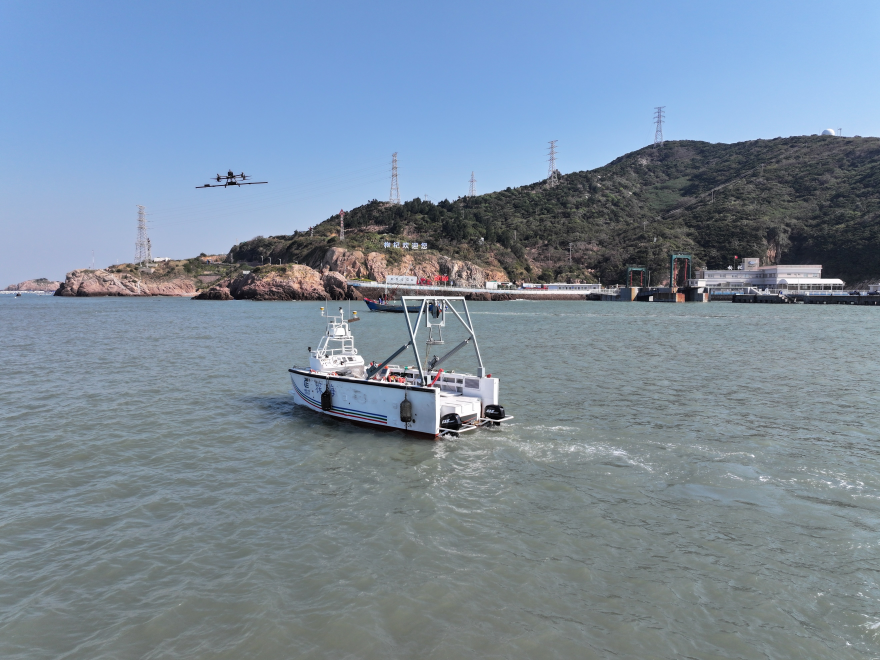
As the vital power "lifeline" connecting the mainland to the islands, the Zhoushan sea area is now home to over 1,000 kilometers of laid submarine power cables. A significant portion of these cables lies in intertidal shallow zones, which have long posed major challenges for O&M inspections due to restricted access for vessels, safety risks for personnel, and data distortion affecting instruments. In traditional operations, large survey ships with deep drafts cannot enter the shallows, while smaller boats have poor wave resistance and their data accuracy is compromised by vibrations and noise. Manual inspections require personnel to risk wading into the water during the short "golden window period" of low tide, resulting in low efficiency and high risk. The core equipment of this latest inspection—an independently developed catamaran USV—is specifically designed to overcome these pain points.
This self-developed and designed USV has a length overall (LOA) of 7 meters, a beam of 3 meters, and a draft of only 0.5 meters. Its catamaran design gives it a unique beaching function, allowing it to easily navigate the "no-go zones" of shallow waters that are inaccessible to conventional ships. Equipped with two 15-kilowatt electric propellers, it can achieve precise low-speed cruises from 0 to 8 knots. Its diesel generator-powered electric propulsion system significantly reduces vibration and noise, providing a stable working environment for acoustic survey equipment. Even more noteworthy is its pioneering forward-detection mode, with full survey coverage in four zones—bow, bottom, sides, and stern. Combined with a bow thruster and an A-Frame deployment system, it can flexibly perform diverse tasks such as cable route surveys and condition monitoring.

At the inspection site, the "Air-Sea-Undersea" collaborative operation unfolded in a stunning display. In the air, a UAV equipped with a high-precision magnetometer swooped in, detecting through sediment layers via a multi-modal fusion algorithm (acoustic-optical-magnetic). It emitted 512 acoustic beams per second to generate a seabed map with 5 cm resolution, transmitting real-time data on cable burial depth and position, completely overcoming tidal restrictions. On the sea surface, the catamaran USV, operating in the country's first Mothership-USV Collaborative Operation Mode with "Zhou Dian 15" as its mothership, efficiently collected data at the forefront and transmitted it synchronously to the mother vessel. This data can be processed by specialized algorithms to generate a "health assessment" for the submarine cable. Underwater, a compact and agile patrol robot navigated freely through reef-strewn areas with its built-in lighting system, continuously checking for wear, displacement, and other hidden dangers on the cable's protective conduits, allowing for precise risk localization.

"A survey task that used to take a manual team three days can now be completed in just half a day with the air-sea collaborative model!" said an O&M staff member from State Grid Zhoushan Power Supply Company. This smart O&M system utilizes "5G + Satellite Communication" for seamless data transmission. Field tests have shown that inspection efficiency is increased by over 80 percent, O&M costs are reduced by 60 percent, and, most importantly, personnel exposure to risk has been reduced to zero. This inspection not only validated core advantages such as controllable low-speed navigation, shallow draft, and high precision, but also established a standardized operational procedure, laying the foundation for a new O&M model based on "mothership-USV collaboration + big data analytics."
The successful execution of the integrated air-sea inspection in the Shengsi waters has not only solved the "no-go zone" dilemma for intertidal O&M but has also propelled China's marine power O&M through a paradigm shift—from "manual risk-taking" to "intelligent risk-avoidance" and from "passive response" to "proactive warning." In the future, State Grid Zhoushan Power Supply Company will continue to deepen its "Air-Sea-Land" collaborative O&M system, leveraging technology to fortify the energy security barrier for island economic development and illuminating the path to green development for thousands of islands with the light of smart power.
(Zhang Cifeng, Wu Jiateng)


Copyright ©1997- by CRI Online All rights reserved
